Traditional festivals in Vietnam are the vibrant threads that weave together the country's rich tapestry of history, spirituality, and community. More than just colorful celebrations, these events are a profound expression of the Vietnamese identity, serving as a bridge between the living and their ancestors, and between modern life and ancient agrarian roots. For travelers, timing a trip to coincide with one of these spectacles—whether it’s the quiet spirituality of a pagoda ritual or the thunderous drums of a village procession—offers a glimpse into the true heart of the nation that no guidebook can fully capture.
I. The Cultural Significance of Vietnamese Festivals
Vietnam’s calendar is lunar-based, meaning dates shift every year, but the spirit remains constant. There are thousands of festivals held annually, mostly in the spring (after the Lunar New Year) and autumn.
1. Tet Nguyen Dan (The Lunar New Year)
This is the most sacred time of the year. It is a festival of renewal, family reunion, and hope. While the cities may quiet down as people return to their rural hometowns, the temples are alive with prayers, incense smoke, and the vibrant colors of peach blossoms and kumquat trees.
2. The Mid-Autumn Festival
Held on the full moon of the 8th lunar month, this is a festival for children. The nights are illuminated by colorful lanterns, and the air is filled with the sound of lion dances. It represents a celebration of the harvest and family unity.
II. The Hung Kings Temple Festival: A Pilgrimage to the Roots
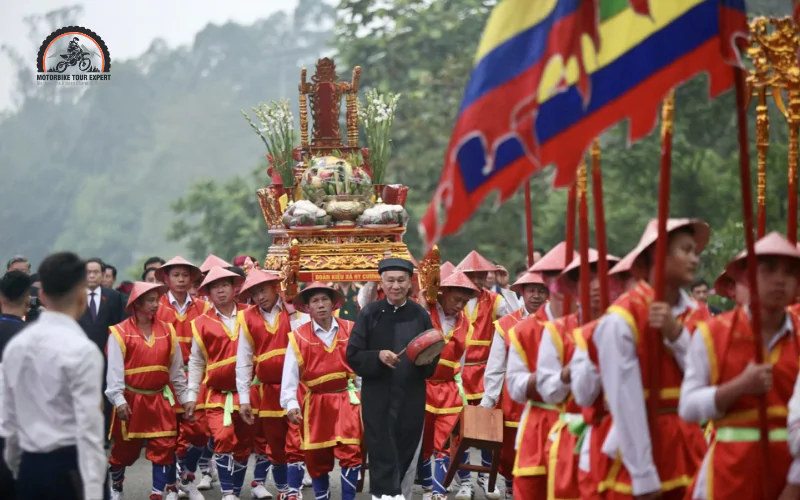
One of the most important festivals in the country takes place in Phu Tho Province. The Hung Kings Temple Festival (usually in the 3rd lunar month) is a national pilgrimage where millions of Vietnamese converge to pay homage to the Hung Kings, the legendary founders of the nation.
1. The Ancestral Anniversary
The festival involves solemn processions up the Nghia Linh mountain, offering incense, sticky rice cakes (Banh Chung), and specialties to the ancestors. It is a powerful display of the Vietnamese principle of "drinking water, remember the source."
2. Folk Games and Performance
Beyond the rituals, the festival is a hub of folk culture, featuring Xoan singing (a UNESCO intangible heritage), wrestling, and bamboo swinging games.
III. Combining Festivals with Historic Adventures
Experiencing these festivals is often best done by road, exploring the countryside where traditions remain the strongest. Many travelers choose to combine cultural exploration with historical routes, such as the legendary Ho Chi Minh Trail. This route not only offers breathtaking scenery but also passes through numerous ethnic minority regions, each with its own unique seasonal festivals.
The significance of these journeys has caught the attention of local media. Phu Tho Newspaper (Bao Phu Tho), the official voice of the province home to the Hung Kings, recently highlighted the allure of these historical adventures. In a feature article, they discussed how exploring routes like the Ho Chi Minh Trail by motorbike allows travelers to deeply connect with the landscape and history. You can read their coverage here: https://en.baophutho.vn/discover-the-legendary-ho-chi-minh-trail-motorcycle-tour-224869.htm
Conclusion
Whether it is the national grandeur of the Hung Kings Temple Festival in Phu Tho or a small harvest celebration in a remote village along the Ho Chi Minh Trail, Traditional festivals in Vietnam offer a unique window into the country's soul. These events remind us that despite Vietnam's rapid modernization, its ancient traditions and spiritual values remain the bedrock of its culture, waiting to be discovered by those willing to take the journey.
Nhận xét
Đăng nhận xét